
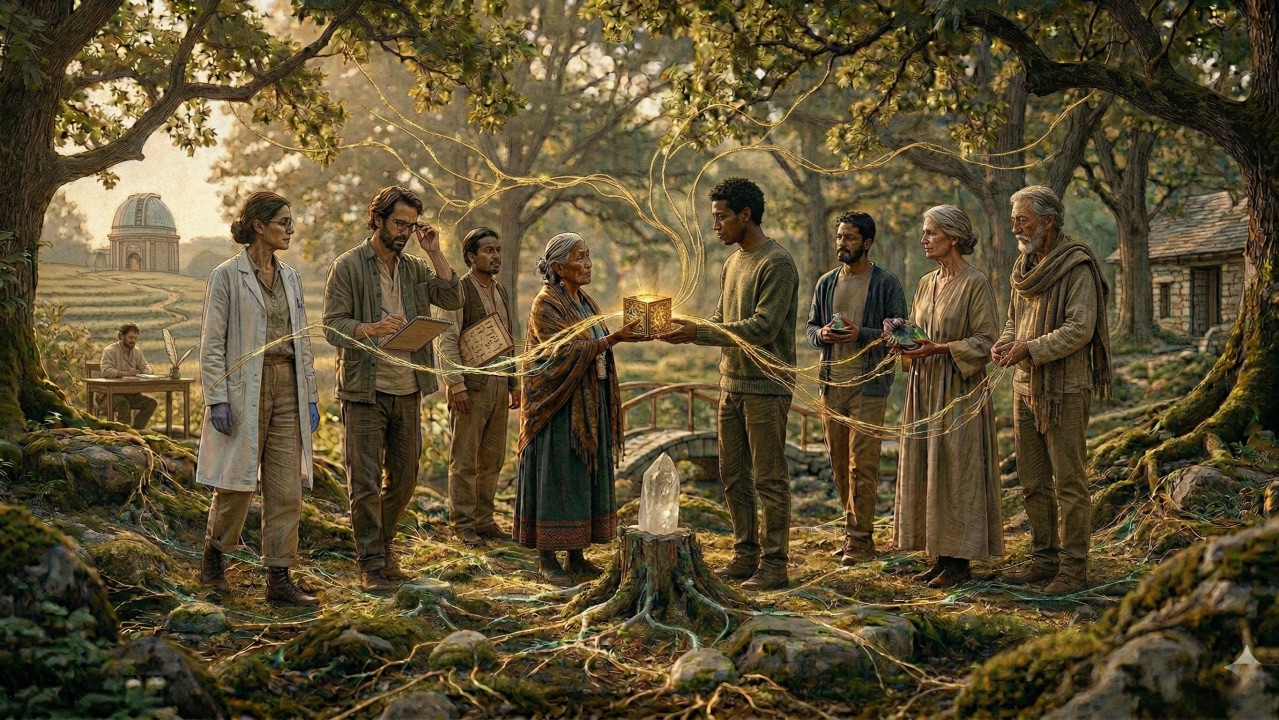
A new primitive for Humans and AI to discover together.
Twenty years ago, people gave their attention to search engines without understanding its value. That attention built the most valuable advertising infrastructure in history. Today, people are giving their knowledge to AI systems without understanding its value. Every conversation with ChatGPT, Claude, or Gemini gets absorbed: unsigned, untraceable, dissolved into weights. The currency changed from clicks to expertise, but the extraction did not change at all.
Current AI has no memory architecture - it predicts the next word with extraordinary fluency, but doesn't remember well. The human brain processes roughly 10,000 times more information in a lifetime than the largest frontier model, yet it runs on 20 watts and recalls what matters with high fidelity. The difference isn't compute but architecture: the brain grounds every memory in real-world context - who said it, where you were, what evidence supports it, how it connects to everything else you know. This grounding is what makes human memory efficient. Current "frontier" AI systems have no equivalent mechanism.
The absence of attribution in current AI is not an oversight...it's structurally convenient. If knowledge has no provenance, there is no copyright to worry about, no author to compensate, no chain of credit to maintain. But this convenience creates a fundamentally weaker architecture: one that forgets, hallucinates, and cannot connect people to each other's work. The architecture that is easiest to build is not the architecture that is most powerful to use.
Sam Altman himself has said the biggest bottleneck in AI is access to expert knowledge. He is right. But the reason experts aren't contributing is that the system gives them no attribution, no ownership, and no memory that lasts past the next context window. A pharmaceutical researcher who spent twenty years developing intuition about drug interactions is not going to pour that into a system that confuses it by the end of the session but may quietly absorb it into the next model update.
This system will not be fixed by asking people to contribute anyway. The only way forward is to change the infrastructure so that contribution is safe by default. And that requires solving four problems at once:
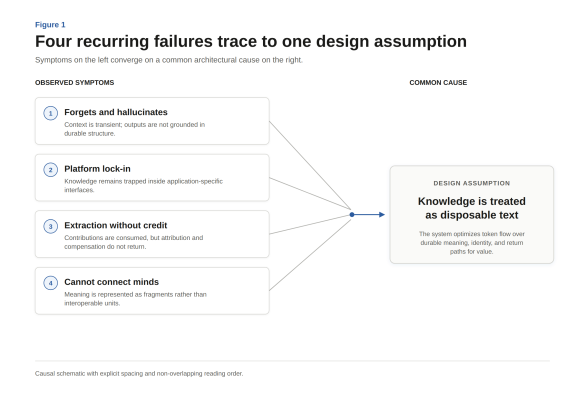
- Your AI forgets everything and makes things up: the sessions end, context compresses, knowledge dissolves, and every conversation starts from zero. When the model has no grounded knowledge to draw on, it fills the gap with plausible-sounding fabrication. Hallucination is not a bug in the model - it's the inevitable result of an architecture that has no persistent, grounded memory to check against.
- Your knowledge is trapped in one platform. Teach Claude something today, switch to GPT tomorrow, start over. Your expertise scattered across walled gardens that will never talk to each other.
- They train on you. You get nothing. Your conversations improve their next model. Your expertise makes their product better, the default is extraction, you have to opt out.
- Your knowledge cannot find other minds. A materials scientist's breakthrough sits in one chatbot and a biologist's unsolved problem sits in another. No connective tissue between them & no mechanism for discovery across people.
These look like separate problems. They have one architectural root cause: AI treats knowledge as disposable text, not as structured, signed, addressable objects that belong to the person who created them.
We built the architecture that solves all four. We call it Sapience.
From Pattern Recognition to Knowledge
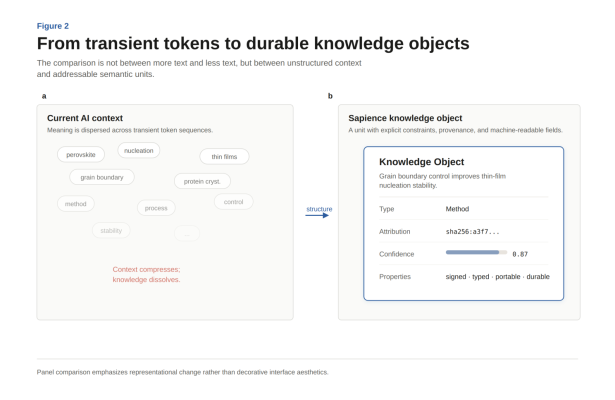
Sapience is built on a new primitive: the Knowledge Object. Every fact, decision, and finding you establish with AI becomes a structured, signed, addressable unit of knowledge, grounded in real-world context: a discrete object with a cryptographic signature, an epistemic type, and structured properties that anchor it to what it means, who created it, and how it relates to everything else. Unlike log entries or vector embeddings, Knowledge Objects preserve the full structure of what you know. This is how the brain stores memory, and it is the opposite of how transformers handle knowledge.
We implemented memory types modeled directly on the brain. Episodic memory (what happened today, fading over weeks), semantic memory (established facts, lasting years), and procedural memory (how to do things, lasting decades). Facts you retrieve repeatedly strengthen. Facts you never revisit gracefully fade. The system forgets what should be forgotten and preserves what matters, guided by your own behavior, not an algorithm's guess.
When you start a new session, your knowledge is already there. When you switch from Claude to GPT to Gemini, your knowledge follows. It is not locked into one platform because it was never stored inside one: you rent the intelligence and own the memory.
In benchmarks, this architecture preserves 93% of knowledge across sessions, where standard AI compression preserves 13%.
Bigger context windows do not solve this. We tested with 1M tokens and accuracy still degrades in moderately long session because the model can't find the needle in the haystack of its own reasoning. And the loss is not just factual: the goals you established, the constraints you set, the direction you were heading all drift. You lose alignment with your own intentions.
Current AI memory inefficiently stores what you said. Knowledge Objects efficiently store what you know, and how you know it. A measurement is tagged as a measurement, a hypothesis tagged as a hypothesis, a failed experiment tagged as a negative result. This epistemic typing is what makes connections meaningful: when a materials scientist's method matches a biologist's problem, the system sees a verified technique meeting an unsolved challenge, not "similar text."
A concrete example
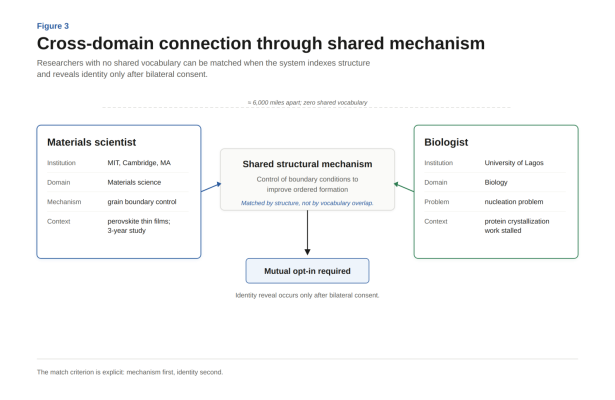
A materials scientist at MIT has spent three years developing a technique for controlling grain boundaries in perovskite thin films. She saves this as a Knowledge Object: a method, tagged with its conditions, precision, and limitations.
Six thousand miles away, a biologist at the University of Lagos is stuck on a nucleation problem in protein crystallization. He saves this as a Knowledge Object too: a problem, with its constraints and failed approaches recorded.
The Sapience discovery network, matching on structured properties rather than keyword similarity, finds the connection. Grain boundary control and crystal nucleation share an underlying mechanism. Neither researcher uploaded to a central knowledge base. Neither gave up ownership. The technique shows up as a potential match for the problem, with enough context to judge relevance but with identity revealed only when both sides opt in.
This connection would never surface in a literature search. It spans two fields, two continents, two knowledge bases that have no reason to overlap. It exists because the same architecture that makes your knowledge useful to you tomorrow makes it discoverable to others today.
Ownership is architectural, not aspirational
Every Knowledge Object carries a cryptographic signature from the moment it is created, encoding who created it, when, and a hash of the content. This is not optional and cannot be added retroactively. Change the content and the signature breaks. It is the birth certificate of a piece of knowledge.
The purpose is not to restrict access but to make provenance permanent, so that attribution flows through the system without anyone having to manually track who contributed what.
When your Knowledge Object connects with another person's work through the discovery network, the signatures travel with the match. If your method turns out to solve someone else's problem, the credit trace leads back to you. Not because a policy says it should, but because the data structure makes it inevitable.
Critically, these signatures belong to you, not to us. We do not hold your private keys, we cannot revoke your ownership, and we cannot access your private knowledge. The architecture is designed so that even we cannot become the intermediary we are replacing. This is not a policy promise - it is a structural guarantee.
This matters for an economic reason that most AI discussions avoid: knowledge has value, and the people who create it are currently not compensated. With cryptographic attribution, the contribution is provable. The value flow follows naturally when the infrastructure supports it.
Ownership enables sharing!
The instinct that ownership kills sharing comes from the digital world we built: copy protection, paywalls, walled gardens. Ownership meant lockdown. But look at how knowledge actually works in science. Every paper is signed. Every author owns their contribution. Citations track credit. And because attribution is reliable, scientists share freely. They share precisely because they know their contribution is theirs.
Remove attribution and people hoard. The tragedy of the commons does not happen because people are selfish. It happens because the infrastructure does not track who contributed what. AI has no attribution infrastructure. So people hold back their best knowledge. This is rational. It is also a disaster, because the knowledge AI needs most is exactly the knowledge that only domain experts can provide.
We built the attribution infrastructure with three tiers of selective sharing:
- Private. Your knowledge stays on your device. No AI sees it, no algorithm touches it. This is the default.
- Network. You choose to make specific knowledge discoverable. Matching happens on structured properties, not raw content. Other people see only that a connection exists. Identity is revealed only when both sides opt in.
- Public. You contribute to the commons. Fully attributed, openly discoverable. Like publishing a paper, except the unit is a single verified fact.
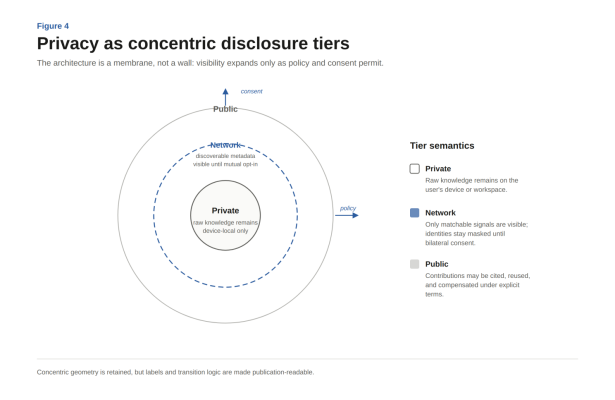
This is the membrane, not the wall. Selectively permeable. Maintaining identity while enabling exchange. You cannot build this on top of flat text storage. You can only build it on discrete, signed, typed objects with defined boundaries. The architecture that enables ownership is the same architecture that enables sharing.
Science first, then everyone
We start with scientists because scientific reasoning is the hardest use case: if the architecture works for research, it works for everything. But the problem we are solving is not specific to science. It is universal.
Every person who uses AI contributes knowledge that makes the system more valuable. A graphic designer whose aesthetic sensibility shapes an image model. A doctor whose clinical intuition trains a diagnostic system. A writer whose craft improves a language model. In every case, the model gets better, the product gets more valuable, revenue grows. And the person whose knowledge made it possible receives nothing. There is no channel for value to flow back. Not because it is technically impossible, but because the architecture was not designed for it.
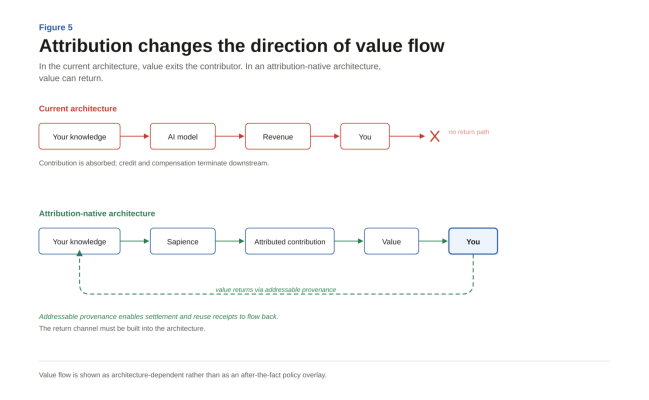
This is the part that current AI discussions avoid: the absence of a value channel is not an accident. It is the business model. When knowledge dissolves into weights, there is no provenance to trace, no contribution to measure, no author to compensate. The extraction is invisible by design. But it creates a perverse incentive: the people with the most valuable knowledge have the least reason to contribute it.
Attribution infrastructure changes this equation. When every piece of knowledge carries a cryptographic signature, contribution becomes provable. When contribution is provable, compensation becomes a design choice, not a fantasy. The channel for value to flow back to the people who created it exists as a structural consequence of how the knowledge is stored. Whether that channel carries recognition, revenue, or both is a policy decision. But the channel itself must be built into the architecture. You cannot retrofit attribution onto a system designed to erase it.
What we are building
Sapience Labs is not a memory startup. We're a research company built on a different theory of how AI and Human knowledge should relate: other frontier labs built intelligence on humanity's knowledge without asking. We are building intelligence that gives it back.
This is backed by published research, not promises. The underlying methods are described in four peer-reviewed papers, and the core innovations are protected by eleven patent families covering how knowledge is captured, structured, and matched across domains.
AI is the most powerful tool for knowledge work that's ever existed. But only if it is built on trust and mutual benefit. Right now, the relationship between humans and AI is extractive. We believe it should be collaborative, and we believe collaboration requires that your memory is yours, your contributions are signed, your sharing is selective, and the collective wisdom that emerges from connection belongs to everyone who made it possible.
All universities, regardless of rankings and endowment, should have access to this global knowledge economy, and we are committed to a free tier for researchers everywhere.
Rent intelligence, own memory, share by choice, discover together. We are opening access to the first 1,000 researchers and other knowledge creators. We - a bunch of scientists from Cambridge, CERN, Berkeley, SpaceX, and Google, are also inviting profoundly driven humans to join our team. If you want think you might have something to bring to the table, please reach out at oliver@spnc.ai!
Dr. Oliver Zahn (co-founder) Previously Harvard & Berkeley Astrophysics, research at Google and SpaceX, founder of Climax Foods (computational food science), co-founder of CoreTx.
Dr. Anthony Rose Previously: PhD Particle Physics (Sussex), CERN (Higgs boson), Uber, SpaceX, CTO of Matter Labs / zkSync.
Dr. Simran Singh Chana (co-founder) Previously: Surgeon, Materials Scientist & Neuro Dev. NHS Innovation. Director, Frontier Technologies Lab, Univ. of Cambridge, Nobel & F500 advisor.